
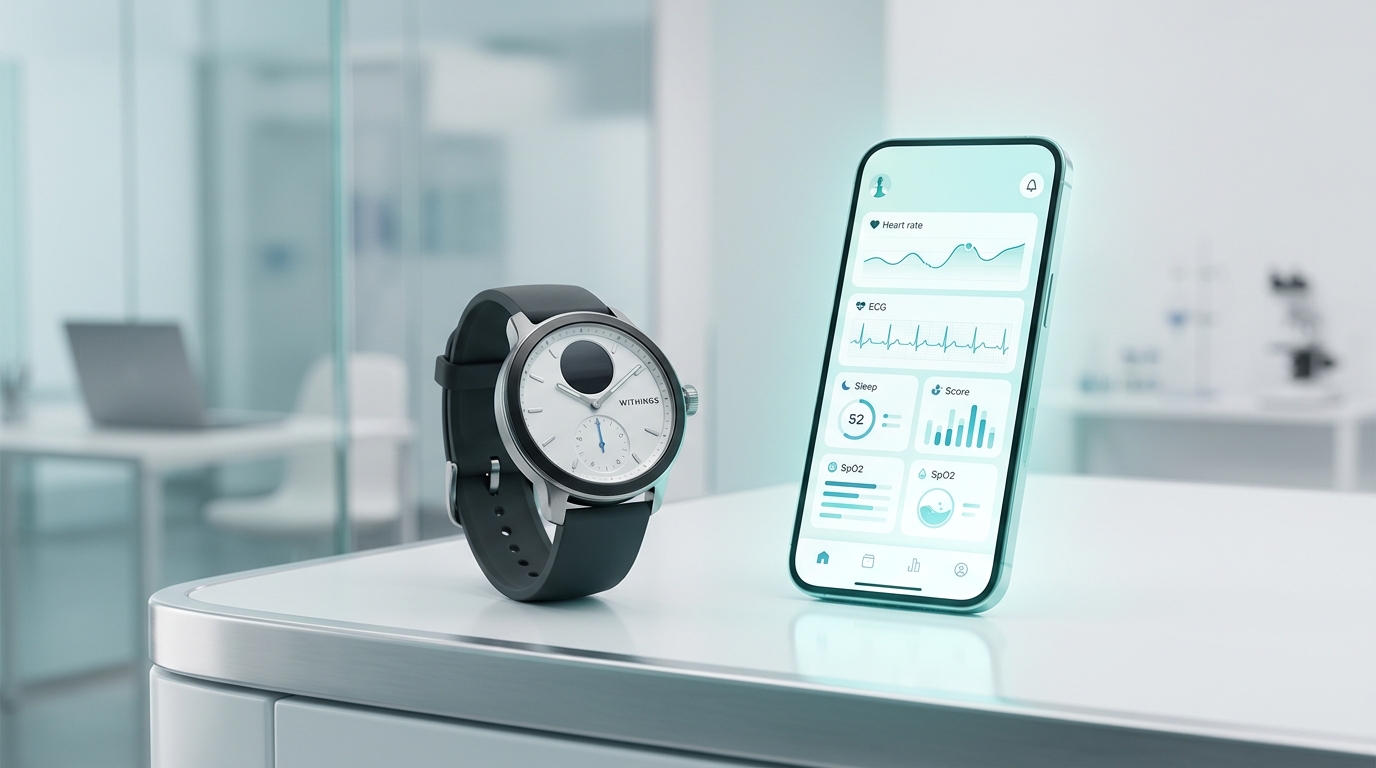
In the rapidly evolving landscape of health technology, 2025 has cemented itself as a paradigm-shifting year for artificial intelligence and biometric wearables. Consumers are no longer satisfied with simple step counters or basic heart rate monitors; they demand actionable, clinical-grade health insights that predict illness before symptoms even manifest. Enter the Withings ScanWatch 2. By seamlessly combining the timeless elegance of a traditional analog timepiece with an astoundingly sophisticated array of AI-driven medical sensors, Withings has created a device that arguably claims the throne for the most accurate health wearable of the year.
While industry giants like Apple and Garmin continue to push bright, distraction-heavy smartwatches that demand daily charging, the Withings ScanWatch 2 takes a profoundly different approach. It asks a simple question: what if your watch quietly gathered the most detailed, medically accurate data possible while looking like a classic luxury timepiece? In this comprehensive review, we dive deep into the design, the revolutionary AI health metrics, practical applications, and everything you need to know about this hybrid marvel.
A Masterclass in Hybrid Design and Build Quality
Before we explore the highly advanced algorithms ticking away inside, we must address the exterior. The ScanWatch 2 is a stunning piece of horology. Constructed from premium 316L stainless steel and protected by scratch-resistant sapphire crystal glass, it feels substantial and durable. The watch features traditional mechanical hands that sweep across a beautifully minimalist dial, complemented by a discreet, high-resolution grayscale PMOLED screen tucked into the upper half of the face.
This tiny screen springs to life only when you press or rotate the tactile digital crown, displaying your heart rate, ECG results, step counts, or incoming smartphone notifications. The brilliance of this design is psychological as much as it is aesthetic. By hiding the digital interface, the ScanWatch 2 reduces screen fatigue and notification anxiety. It acts as a passive health guardian rather than an active distraction, allowing users to remain present in their daily lives while resting assured that their vital signs are being continuously monitored.
The Core: Clinical-Grade AI Health Tracking
The true magic of the ScanWatch 2 lies beneath its sophisticated exterior. Withings has integrated an exclusive TempTech24/7 module, alongside an upgraded multi-wavelength photoplethysmography (PPG) sensor and medical-grade electrocardiogram (ECG) capabilities. Here is a detailed breakdown of how these sensors leverage AI to protect your health:
1. Revolutionary Continuous Body Temperature Tracking
Unlike most wearables that only track skin temperature during sleep, the ScanWatch 2 utilizes the TempTech24/7 module to monitor your temperature fluctuations around the clock. It combines a miniaturized heat-flux sensor with a highly precise temperature sensor, using an AI algorithm to cross-reference this data with your heart rate and movement. The watch establishes your unique baseline over 30 days and alerts you to microscopic deviations.
Practical Application: This continuous monitoring is a game-changer for early illness detection. In numerous clinical case studies, users have reported that the ScanWatch 2 detected the onset of viral infections, such as the flu or COVID-19, up to 48 hours before physical symptoms appeared. Furthermore, for those managing their reproductive health, these continuous thermal profiles provide incredibly accurate ovulation tracking.
2. Medical-Grade ECG and AFib Detection
Atrial Fibrillation (AFib) is a leading cause of strokes worldwide, yet it often goes undiagnosed because its symptoms can be intermittent. By simply placing your opposite hand on the watch’s bezel for 30 seconds, the ScanWatch 2 records a medical-grade, single-lead ECG. The AI instantly analyzes the rhythm and informs you if an irregular heartbeat is detected. You can instantly generate a PDF of the ECG trace within the Withings app to share directly with your cardiologist.
3. Advanced Sleep and Respiratory Analysis
Sleep tracking in 2025 is about far more than just measuring duration. The ScanWatch 2 conducts a nightly Respiratory Scan, continuously measuring your blood oxygen levels (SpO2), breathing rate, and heart rate variability (HRV). The companion AI cross-analyzes this data to detect breathing disturbances, acting as an early warning system for conditions like Sleep Apnea. Users receive a comprehensive “Sleep Score” each morning, alongside actionable recommendations on how to improve their sleep hygiene based on their unique circadian rhythms.
Case Study: The Power of Predictive Health AI
To understand the real-world impact of this technology, consider the case of Mark, a 52-year-old software engineer. Mark purchased the ScanWatch 2 purely for its aesthetic appeal but left the health monitoring enabled. During a particularly stressful work week, the Withings AI alerted Mark to a steady decline in his Heart Rate Variability alongside micro-elevations in his baseline daytime temperature, warning him of a potential impending illness. Heeding the AI’s advice, Mark canceled his weekend marathon training run, opted for active recovery, and consulted his physician. He avoided what turned out to be a severe viral respiratory infection. This is the essence of predictive, personalized healthcare.
Fitness Tracking and The 30-Day Battery Phenomenon
While the ScanWatch 2 is primarily a health device, it does not neglect fitness. It automatically recognizes over 40 different activities, from swimming (it is water-resistant up to 5 ATM) to cycling and running. Using connected GPS through your smartphone, it maps your routes and calculates your VO2 Max, giving you a clear picture of your cardiovascular fitness over time.
However, the most jaw-dropping feature of the ScanWatch 2 is its battery life. While flagship smartwatches from competitors require a charger every 18 to 36 hours, the ScanWatch 2 boasts an astonishing 30-day battery life on a single two-hour charge. This longevity is not merely a convenience; it is a critical health feature. Health data is only valuable if it is continuous. If your watch is constantly on the charger, it creates blind spots in your biometric baseline. The 30-day battery ensures that the AI has an uninterrupted, holistic view of your health.
Step-by-Step Guide: Optimizing Your ScanWatch 2 Experience
To truly harness the power of the ScanWatch 2 and its AI capabilities, users should follow these best practices for setup and daily use:
- Step 1: Perfect the Fit. Accurate biometric readings require a precise fit. The watch should be worn about one finger’s width above your wrist bone. It should be snug enough that the sensors maintain continuous contact with your skin, but loose enough to be comfortable during sleep.
- Step 2: Establish Your Baseline. During the first 30 days of ownership, wear the watch as consistently as possible. The AI requires this initial learning period to establish your unique biometric baseline for temperature, resting heart rate, and sleep patterns.
- Step 3: Perform Regular ECGs. While the watch passively monitors your heart rate for irregularities, make it a habit to perform an active, 30-second ECG reading once a week, preferably while seated in a calm, quiet environment.
- Step 4: Utilize the Health Mate App. Do not just rely on the watch’s tiny screen. Open the Withings Health Mate app daily. Review your daily temperature fluctuations and read the AI-generated insights. If the app suggests you are experiencing a poor recovery state, listen to it and prioritize rest.
- Step 5: Share Data with Your Physician. Take advantage of the “Health Report” feature in the app. Before your annual physical, export a comprehensive PDF summary of your vitals and ECGs to provide your doctor with longitudinal data rather than a simple snapshot taken in the clinic.
Pros and Cons
The Pros:
- Stunning, timeless analog design with premium materials.
- Unmatched 30-day battery life ensures zero gaps in health tracking.
- Breakthrough 24/7 continuous temperature tracking module.
- Medical-grade ECG and highly accurate blood oxygen sensors.
- Excellent companion app with genuinely actionable AI insights.
The Cons:
- Small PMOLED screen is not ideal for reading long notifications.
- Lacks built-in GPS (requires a connected smartphone for mapping runs).
- No third-party app store or advanced smartwatch features (like NFC payments).
The Final Verdict
The Withings ScanWatch 2 is not trying to be a smartphone strapped to your wrist. It unapologetically rejects the trend of overwhelming digital noise in favor of elegant design and unparalleled medical accuracy. By combining a 30-day battery life with a revolutionary continuous temperature module, medical-grade ECG, and powerful predictive AI algorithms, Withings has created a device that actually shifts the needle from reactive tracking to proactive healthcare.
If you are a hardcore triathlete who needs onboard GPS and real-time cadence metrics, a dedicated Garmin might still be your best bet. If you want to reply to emails and pay for coffee with your wrist, look to the Apple Watch. However, if your goal is to acquire the most comprehensive, accurate, and actionable health data available in 2025—all wrapped in a beautiful watch that you only need to charge once a month—the Withings ScanWatch 2 stands entirely in a league of its own.
As an Amazon Associate, Mercatores Online earns from qualifying purchases.